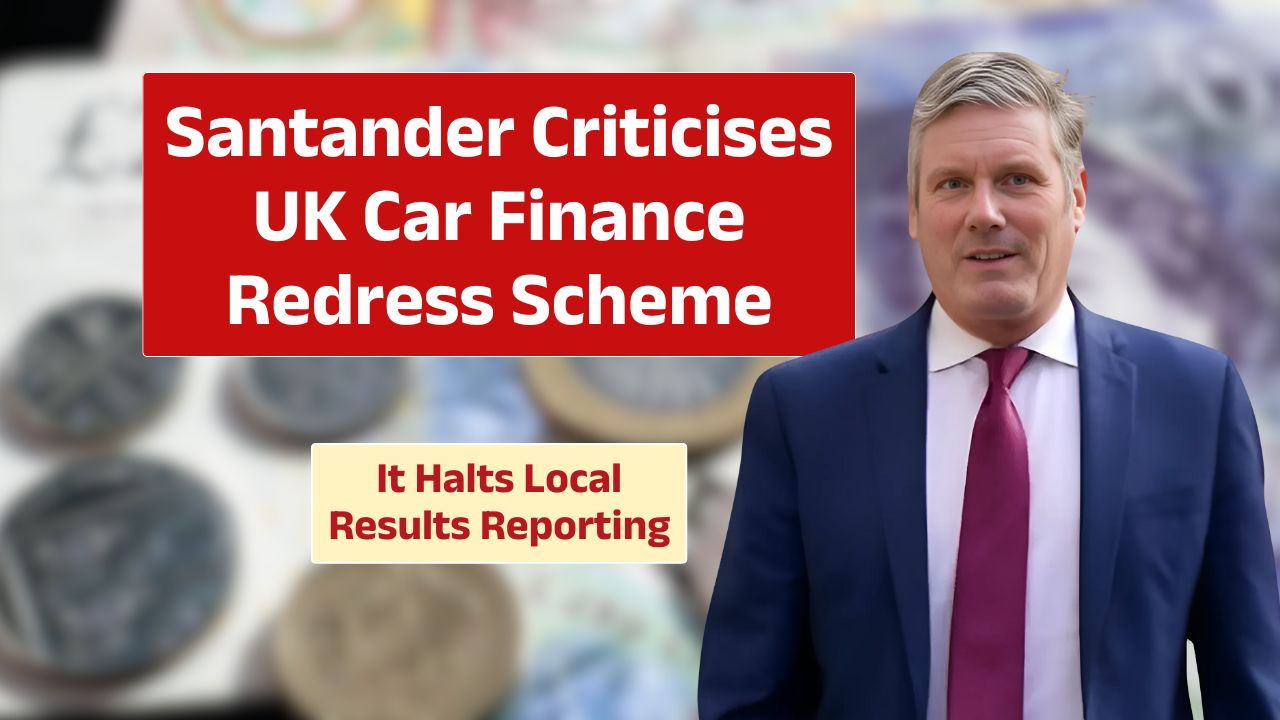
Santander has opted not to publish its UK third-quarter results, citing growing uncertainty over the Financial Conduct Authority’s (FCA) proposed car finance redress scheme. The Spanish banking giant has raised concerns about the potential economic fallout of the £11 billion compensation plan, warning it could impact job security, credit availability, and the broader UK auto industry.
Table of Contents
Overview
The FCA is currently consulting on a large-scale compensation scheme designed to reimburse consumers who were mis-sold car finance deals. These deals often included hidden commissions paid to car dealers—something many buyers were not made aware of.
While the FCA believes this redress is necessary to restore trust in the car finance market, banks and lenders have pushed back, saying the scope and scale of the scheme are disproportionate.
Among them, Santander has taken a bold step by not releasing its UK financial figures for Q3 2025, a move intended to reflect its serious concerns about the ongoing regulatory developments.
Background
This potential £11 billion compensation plan would be one of the largest financial hits the UK lending industry has faced. Initially, the estimated cost of redress was £44 billion, but a Supreme Court ruling in August narrowed the scope and brought the figure down.

Despite this reduction, major lenders such as Lloyds Banking Group have already begun to make provisions, with Lloyds setting aside almost £2 billion. Santander has previously reserved £295 million, but that figure is likely to be revised once there’s clarity on the FCA’s final approach.
Santander’s Position
Mike Regnier, Santander UK’s outgoing CEO, stated that the FCA’s proposed scheme could have unintended consequences. He called on the UK government to reconsider the scope of the redress framework to prevent damage to the country’s credit markets and automotive supply chain.
He argued that without intervention, the scheme could stall credit supply, hurt vehicle sales, disrupt dealer networks, and affect thousands of jobs.
By not publishing UK-specific Q3 results—something it typically does—Santander is clearly sending a message that the stakes are high. However, the bank did confirm that a financial update would be included in its year-end figures.
Industry Response
Santander’s stance is part of a broader industry-wide backlash. Many banks believe that the FCA’s model overstates the actual harm caused to consumers and fails to take into account that buyers may not have suffered significant financial loss.

The core issue revolves around disclosure: consumers weren’t informed that dealers received a commission tied to the interest rate of the loan, potentially incentivising higher rates.
The UK government is watching the situation closely. Earlier this year, Chancellor Rachel Reeves voiced concern that large-scale payouts could make the UK less attractive for investment and place stress on financial institutions.
FCA’s Response
In response to the criticism, the FCA has defended its approach. In a statement, the regulator said that a structured compensation scheme is the most effective way to resolve liability for both consumers and lenders.
They argued that the alternatives would be more expensive and slower to resolve. The goal, according to the FCA, is to put the issue to rest and ensure the motor finance market remains sustainable and trusted.
Financial Performance
While Santander withheld its UK data, it still published group-level results. Across the group, net income rose by 8 percent year-on-year to €3.5 billion—marking its sixth consecutive record quarter. Strong performance in the United States helped offset a 3.5 percent revenue decline in its UK business, which brought in €1.3 billion. Net operating income in the UK was flat at €629 million.

Santander indicated that while it expects to increase the £295 million set aside for UK car finance compensation, it does not anticipate the increase will materially impact the bank’s overall financial position.
Looking Ahead
As the FCA’s consultation continues, pressure is mounting from all sides. Lenders are lobbying for a scaled-back version of the scheme, while consumer advocates argue that fair compensation is long overdue.
Santander, meanwhile, has made its stance clear: it wants changes to be considered at the government level, fearing that the current direction could create ripples throughout the wider economy.
As of now, all eyes remain on the FCA’s next steps and how the UK government chooses to respond.
FAQs
Why did Santander skip UK Q3 results?
Due to uncertainty over the FCA car finance redress scheme.
What is the FCA redress scheme for?
To compensate consumers mis-sold car finance with hidden commissions.
Is Santander the only bank impacted?
No, other banks like Lloyds have also set aside funds.
How much could the scheme cost?
FCA estimates a total industry cost of £11 billion.
Has Santander updated its provisions?
Not yet, but an update is expected in Q4 results.