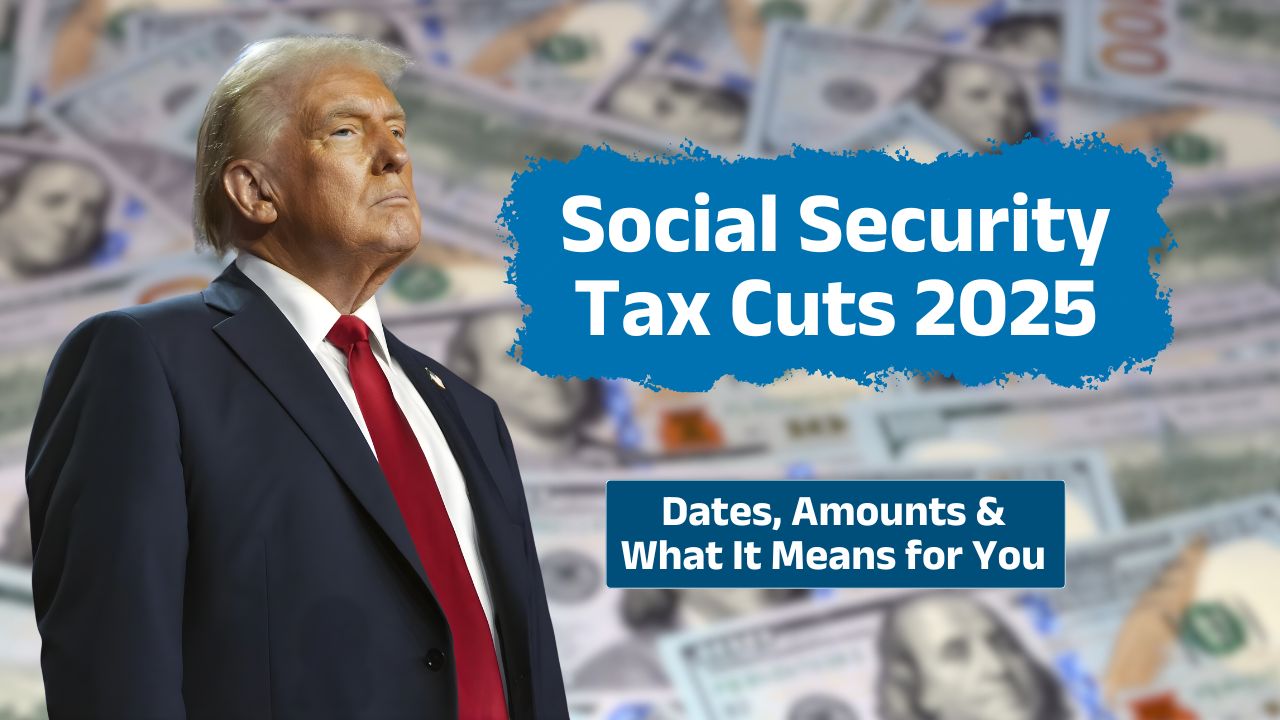
If you’re receiving Social Security benefits, 2025 is about to bring some welcome news. Starting November 4, a brand-new tax rule is kicking in, offering significant tax cuts for senior citizens. The idea? Help retirees keep more of their income by lowering how much they owe in federal taxes or, for many, eliminating the tax bill entirely.
Let’s break down exactly what this means, who qualifies, how much you can save, and what to watch out for in the future.
Table of Contents
Update
The new Social Security tax cuts are now in effect as of November 4, 2025. This temporary law, valid until 2028, targets Americans over 65 and aims to reduce taxable income by offering extra deductions. For many retirees, this means no more federal income tax on their benefits. But for others, especially those earning above certain limits, the benefits might be phased out.
Also Read: Bank Alert – These Banks Are Rejecting Mobile Deposits for $400 New York Inflation Refund Checks
Here’s a snapshot of the new update:

| Category | Details |
|---|---|
| Country | USA |
| Year | 2025 |
| Authority | US Government |
| Effective Date | November 4, 2025 |
| COLA Increase | 2.5% |
| Tax Relief | Extra $6,000 (singles), $12,000 (married) |
| Duration | 2025 to 2028 |
| Official Info | www.ssa.gov |
Deductions
The headline change is the $6,000 deduction for singles and $12,000 for married couples over age 65. These deductions are applied directly to your taxable income, reducing it significantly. That means if you’re a retiree on a fixed income, you’ll likely owe less—or nothing at all—on your Social Security payments.
Let’s say you’re a single retiree earning $30,000 a year. With the new $6,000 deduction, your taxable income drops to $24,000. Depending on other factors, you could avoid federal income tax completely.
Eligibility
Most retirees are in for good news. According to estimates, about 90% of senior citizens will pay zero federal taxes on their Social Security benefits due to the new deduction. This change is especially beneficial to those living on modest incomes.
However, if you’re earning more—say over $65,000 as a single filer or over $150,000 as a couple—your eligibility for the full deduction starts to phase out. Once your income exceeds $75,000 (single) or $165,000 (married), the benefit may disappear completely.
Duration
This tax relief isn’t forever. It’s valid only from 2025 to 2028. After that, unless Congress extends or changes the law, the deductions will end, and tax rules could return to previous levels.

If you’re planning your retirement cash flow, don’t count on these tax cuts lasting beyond 2028. Use the benefit now to save or reinvest wisely.
Impact
The immediate impact is clear—lower taxes and more disposable income for millions of senior citizens. It’s a short-term win, especially with the cost-of-living adjustment (COLA) for 2025 only at 2.5%, which many say doesn’t keep up with inflation.
However, there’s a flip side. With fewer tax dollars flowing in, the federal government may face a drop in revenue. That raises concerns about the long-term stability of Social Security funds. If funding shortages grow, future retirees could face benefit cuts unless a new solution is found.
Concerns
While this feels like a financial breather, experts are warning about the potential long-term risks. Lower tax revenue from retirees means fewer dollars going back into the system. If Congress doesn’t balance it out, future Social Security payouts could take a hit.
Some analysts already predict that without changes, the Social Security trust fund could face a shortfall. While that won’t affect today’s retirees immediately, it’s something to keep in mind as you plan ahead.

Relief
Still, for now, the relief is real. If you’re retired, especially on a fixed income, the extra tax deduction can mean hundreds—or even thousands—saved each year. That’s money you can use for health care, living expenses, or simply enjoying your retirement.
For those not yet retired, it’s a reminder to stay informed. Tax laws change, and knowing how they affect your future benefits is just as important as how much you save today.
FAQs
When does the tax cut start?
It starts on November 4, 2025 across the U.S.
How much is the new deduction?
$6,000 for singles and $12,000 for married couples.
Who qualifies for the tax cut?
Most retirees over 65 with income under set limits.
Is the tax cut permanent?
No, it’s temporary from 2025 to 2028.
Will it affect future benefits?
Possibly, if it lowers Social Security funding.